Key takeaways
A University of Arizona study modeled homes in the Midwest and found that over 60% of house dust comes from outdoors, as tracked-in soil and airborne particles.
UGA Extension says the heaviest concentration of household dust is in the carpet near the entryway, which is why doormats and a shoes-off rule come first.
Mayo Clinic recommends a damp or oiled cloth or mop over a dry one, so dust doesn't float into the air and settle again.
The EPA suggests a furnace filter rated at least MERV 13, or as high as your system can take, and notes that HVAC filters only clean air while the system is running.
The AAFA says dust mites like humidity above 50% and recommends keeping indoor humidity between 30% and 50%.
Where household dust comes from
Dust isn't one thing. Researchers Paloma Beamer and David Layton at the University of Arizona describe it as a mix of dead skin, fibers from carpets and upholstered furniture, tracked-in soil, and airborne particles that blow in from outside. Their computer model of homes in the Midwest found that over 60% of house dust originates outdoors.
UGA Extension lists insect fragments, pollen, and dust mites among the ingredients, and says dust comes in on shoes and clothing and on pets' paws and fur. It estimates that about 30% to 40% of the contaminants inside a home are brought in from outdoors.
That mix explains why dusting alone never quite keeps up. You can't stop people from shedding skin. You can cut what comes through the door, pick up what's already inside, and keep humidity in a range dust mites don't like, and the routine below covers each of those.
A room-by-room dust routine for heating season
This schedule spreads the work across the week so no single day is a big clean.
Room or area | Every week | Every one to three months |
Entryway | Shake or wash doormats; vacuum the carpet nearest the door | Wash or replace mats |
Bedrooms | Wash sheets, pillowcases, and blankets in hot water; damp-dust surfaces | Vacuum the mattress |
Living room | Damp-dust from top to bottom; vacuum rugs and upholstery | Wash curtains and throw pillow covers |
Kitchen and bathrooms | Wipe counters and shelves; damp-mop floors | Clean vent covers and exhaust fan grilles |
Whole house | Vacuum with a HEPA vacuum | Check and change the furnace filter |
The weekly bedding wash and vacuuming come from Mayo Clinic and UGA Extension. The AAFA suggests vacuuming the mattress every one to three months, and Mayo Clinic says to change the furnace filter every three months.
1. Stop dust at the door
If most dust starts outside, it's worth stopping it at the entryway. UGA Extension says the greatest concentration of household dust sits in the carpet near the entryway, because carpet acts like a doormat and scrapes debris off every shoe.
Put a mat at every exterior door. UGA Extension says adding a doormat reduces the time and effort it takes to clean the house.
Take shoes off at the door. UGA Extension recommends removing shoes and leaving them there.
Wipe paws. Pets track in soil and contaminants on their paws and fur, according to UGA Extension, so a towel by the back door helps.
2. Dust from top to bottom with a damp microfiber cloth
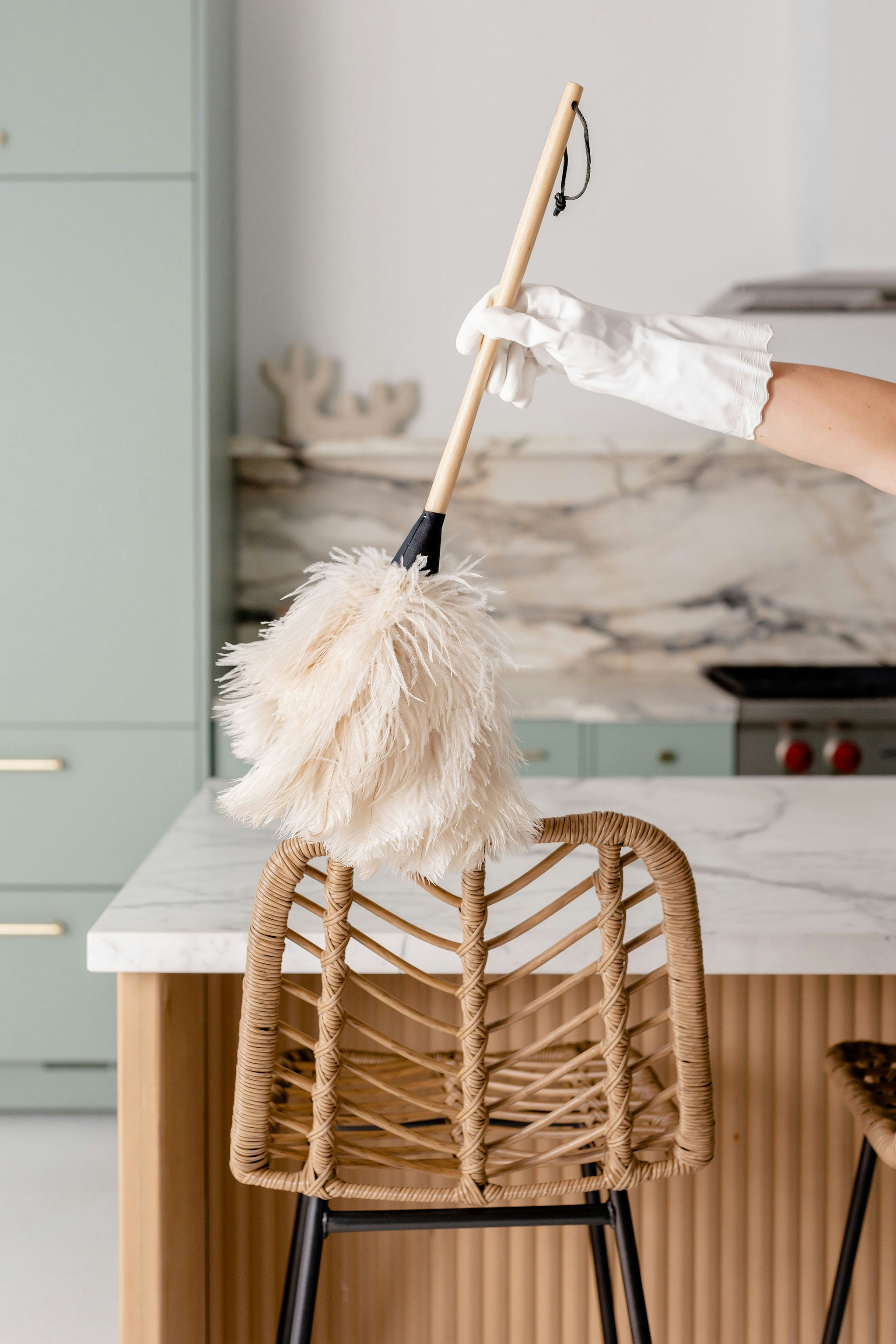
Dry dusting moves dust around. Mayo Clinic recommends a damp or oiled cloth or mop over a dry one, which keeps dust from going into the air and coming back down. UGA Extension's healthy-home tips suggest dusting with a microfiber cloth.
Work from the top of each room down: ceiling fan blades, the tops of door frames and shelves, picture frames, then tables, then baseboards. That way anything that falls lands on a surface you haven't cleaned yet, and the vacuum picks it up at the end.
Don't skip the spots people forget: lampshades, the top of the refrigerator, window blinds, and electronics. Mayo Clinic suggests swapping horizontal blinds for washable roller shades and using washable curtains in rooms where dust is a problem.
3. Vacuum weekly with a HEPA vacuum
UGA Extension recommends vacuuming at least once a week with a HEPA vacuum, or a vacuum with a HEPA air filter. Mayo Clinic suggests a vacuum with a HEPA filter or a double-layered microfilter bag, and the AAFA notes that a poor-quality vacuum can put dust back into the air. Our cordless stick vacuum guide compares models with HEPA filtration.
On hard floors, UGA Extension suggests a damp mop in place of a broom. Mayo Clinic adds that if you have severe allergies, someone else should do the vacuuming, and you should wait about two hours before going back into the room.
4. Wash bedding weekly in hot water
The bedroom deserves extra attention because of what's in the bed. The AAFA says dust mites feed mainly on the flakes of skin people shed every day, and that they're common in bedding, carpets, furniture, and stuffed toys.
Mayo Clinic's advice is to wash sheets, blankets, pillowcases, and bedcovers every week in water of at least 130°F. If something can't be washed that hot, put it in the dryer for at least 15 minutes above 130°F. Allergen-proof covers on mattresses and pillows keep dust mites from escaping, according to Mayo Clinic.
5. Upgrade and change the furnace filter
In heating season, the furnace filter is working on the whole house. The EPA's guide to air cleaners in the home suggests a filter rated at least MERV 13, or as high as your system will accommodate. It says most systems can take a MERV 13 filter if it's replaced often, and recommends checking with an HVAC technician.
The EPA also notes that an HVAC filter only cleans the air while the system is running, usually less than 25% of the time during heating and cooling seasons. Mayo Clinic suggests leaving the fan on to turn the system into a whole-house air filter, and changing the filter every three months.
6. Clear the clutter that collects dust
Every object on a shelf is another surface to dust. The AAFA recommends reducing clutter because dust collects on it, and Mayo Clinic suggests removing knickknacks, tabletop ornaments, books, magazines, and newspapers from the bedroom.
You don't need to empty the house. Start with the bedroom and the shelves you dust most often, and box up or donate what you don't use. Our room-by-room decluttering plan walks through the whole house, from the entryway to the garage.
7. Keep humidity between 30% and 50%
Humidity comes into it because of dust mites. The AAFA says dust mites like humidity above 50%, and recommends keeping a home between 30% and 50%. Mayo Clinic suggests holding relative humidity below 50% and checking it with a hygrometer from a hardware store.
The EPA gives the same 30% to 50% target. When heated winter air reads below 30% on the hygrometer, the EPA suggests a humidifier to raise it. In damp seasons, a dehumidifier or air conditioner brings it down, according to the AAFA.
8. Add a portable air cleaner where you spend the most time
A portable air cleaner keeps catching fine particles between cleanings. The EPA says the higher a unit's clean air delivery rate (CADR), the more particles it removes and the larger the area it can serve, and that many portable units reach a high CADR with a HEPA filter.
Size it to the room. The EPA's chart calls for a CADR of at least 130 cfm for a 200-square-foot room and 260 cfm for 400 square feet, assuming an 8-foot ceiling. Place it in the room where you spend the most time, keep the airflow clear of curtains and furniture, and skip any device that intentionally produces ozone.
What about Saharan dust?
Saharan dust is a seasonal event that reaches some parts of the US. NOAA says Saharan Air Layer activity typically ramps up in mid-June and peaks from late June to mid-August, with new outbreaks every three to five days. During that peak, outbreaks can reach as far west as Florida, Central America, and even Texas.
N.C. Cooperative Extension says the fine particles can irritate the eyes, nose, and throat and aggravate allergies and asthma. Its advice for those days is to keep windows and doors closed, and if you have air conditioning, to keep the fresh-air intake closed. A portable air cleaner and a fresh furnace filter keep working on whatever gets in.
Where to start this week
There's no need to do all eight at once. If dust is getting ahead of you, this order starts at the door and the bed:
Put a doormat outside and inside each exterior door, and set up a spot for shoes.
Strip the beds and wash everything in water of at least 130°F.
Damp-dust the bedroom from the top down, then vacuum it with a HEPA vacuum.
Pull out the furnace filter, note its MERV rating, and replace it if it's been three months.
Put a hygrometer in the bedroom and check that it reads between 30% and 50%.
Clear one cluttered shelf or nightstand.
Repeat the bedding wash and vacuuming each week, and work through the rest of the table as each item comes due.
Frequently asked questions
Why is my house so dusty?
Mostly because of what comes in from outside. A University of Arizona study found over 60% of house dust originates outdoors, carried in on shoes and through the air, so doormats and a shoes-off rule are the place to start.
Can you get rid of dust completely?
No, but you can keep it down. Dust includes skin that people shed every day, so the goal is a regular routine: stop it at the door, damp-dust, vacuum with HEPA, and filter the air.
How often should I dust my house?
About once a week. Mayo Clinic's weekly bedding wash and UGA Extension's weekly HEPA vacuuming set a natural rhythm, with damp-dusting on the same day.
Is it better to dust or vacuum first?
Dust first. Working from the top of the room down means anything that falls ends up on the floor, where the vacuum collects it last.
What MERV filter is best for dust?
MERV 13, if your system can take it. The EPA recommends at least MERV 13 or as high as your system will accommodate, and suggests checking with an HVAC technician.
Do air purifiers help with dust?
Yes, for airborne particles. The EPA says a higher CADR removes more particles, and recommends sizing the unit to the room, such as 130 cfm for 200 square feet.
How do I keep Saharan dust out of my house?
Close up the house. N.C. Cooperative Extension advises keeping windows and doors closed and the air conditioner's fresh-air intake shut while the dust is overhead.
NB
Written by
Organizing, laundry, and comfort
Nora writes about organizing, laundry, and keeping a home comfortable through the seasons, with steps that fit into a busy week.


